
What is an Actuator? Mechanisms, Types, and Applications Explained

An actuator is a device that converts energy—such as electricity, pneumatic pressure, or hydraulic pressure—into physical motion. It acts like the "muscle" that supports the movement of various machines around us, including smartphones, automobiles, and industrial robots.
This article explains the roles and mechanisms of actuators, details the characteristics of different types (electric/electromagnetic, hydraulic, and pneumatic), and introduces the various fields where they are utilized.
1. Roles and Mechanisms of Actuators
Actuator is a general term for devices that convert energy obtained from electricity, air, or hydraulics into physical "motion." Here, we explain the main roles of actuators and the mechanisms by which they convert energy into motion.
Main Roles of Actuators
Actuators are indispensable as driving sources for industrial machinery, robots, medical equipment, home appliances, and more. In every aspect of modern society, actuators serve as the "muscles" that physically move machines.
Actuators can generate various types of motion: "linear motion" in one direction, continuous "rotary motion," and "oscillating motion" that reciprocates within a specific range. The optimal type is selected based on the application and purpose.
Basic Mechanism of Actuators
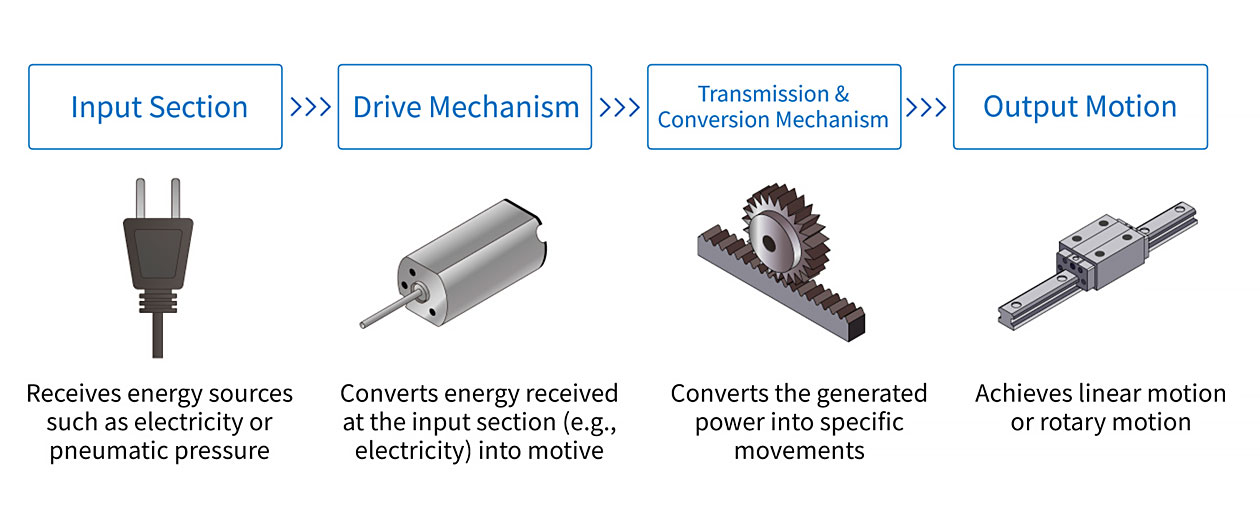
The process by which an actuator converts energy into motion mainly consists of three elements: the "Input Section," the "Drive Mechanism," and the "Transmission and Conversion Mechanism."
■ Three Elements of an Actuator
Input Section
Drive Mechanism
Transmission and Conversion Mechanism
The combination of these elements determines the actuator's controllability, operating speed, and generated force.
■ The Process of Actuators Converting Energy into Motion
2. History of Actuators and Technological Evolution
Since ancient times, humanity has created technologies to convert natural energy into motive power, such as watermills and windmills. These can be seen as the prototypes of actuators.
Following the Industrial Revolution, with the development of steam engines and internal combustion engines, various mechanisms for converting energy into power were developed. In the 20th century, hydraulic and pneumatic actuators, capable of delivering high output, began to spread across the industrial sector. Furthermore, since the late 20th century, the application range of electric (electromagnetic) actuators has expanded dramatically due to advancements in electronics.
Today, with the further enhancement of compact motors' performance, electric (electromagnetic) actuators have become an essential component in all fields requiring precise control, such as robotics, home appliances, and automobiles.
3. Types of Actuators and Their Characteristics
Currently, the four most representative types of actuators used in industry and daily life are electric (electromagnetic), hydraulic, pneumatic, and piezoelectric actuators. Let's look at their respective driving principles and characteristics.
Electric (Electromagnetic) Actuators
Electric (electromagnetic) actuators use a method (electromagnetic drive) that converts input electrical signals into a magnetic field (magnetic force) and utilizes the force generated within that magnetic field to drive motors and other components. The basic principle is based on "Fleming's left-hand rule," and they can be classified into the following types depending on the mechanism:
■ General Mechanisms Utilizing Motors
This type is characterized by its highly precise positioning and speed control. It also allows for multi-point stopping and complex motion programming, making it highly suitable for automated lines and IoT devices. While its maximum thrust may be inferior to hydraulic systems, it excels in energy efficiency.
■ Linear Resonant Actuators (LRA)
Through this enriched tactile expression, they are utilized in a wide range of fields as key devices that create a realistic operating feel, including haptics (tactile feedback) in smartphones.
Hydraulic Actuators
Hydraulic actuators operate by applying high pressure to oil (hydraulic fluid) using an electric pump and transmitting that pressure to cylinders or motors to drive them. Utilizing the practically incompressible nature of liquids, oil functions as the medium for pressure transmission.
Because hydraulic actuators can generate massive force, they are well-suited for construction machinery and large press machines. However, consideration must be given to the need for piping facilities, which can make the equipment bulky, as well as the risk of oil leaks and the maintenance required, such as periodic fluid replacement.
Pneumatic Actuators
Pneumatic actuators use air pressure compressed by a compressor as an energy source to move components like air cylinders.
The advantages of pneumatic actuators include their simple structure, low cost, and light weight. Furthermore, they offer fast operating speeds and are easy to handle, as they can safely stop in the event of an overload. However, because air is "compressible," they are not well-suited for precise positioning control, such as stopping exactly mid-stroke. Additionally, their energy efficiency tends to be lower than that of electric (electromagnetic) or hydraulic types.
Piezoelectric Actuators
Piezoelectric actuators generate minute displacements and precise vibrations by utilizing the piezoelectric effect, a property in which the material itself deforms when voltage is applied to a piezoelectric element (piezo element).
Featuring rapid response times and the capability for ultra-fine, nanometer-level positioning, piezoelectric actuators excel at high-precision operations. On the other hand, because the distance moved in a single operation (stroke length) is short, they are not suitable for applications requiring large displacements.
4. Application Fields for Actuators
Actuators are utilized in a wide variety of fields. Here, we will look at specific use cases in four representative sectors.
Automotive

Modern automobiles rely on actuators for so many drive units that they could be called "a mass of running actuators." Electric (electromagnetic) actuators are used not only in parts related to automotive safety, such as brake control and wipers, but also in parts supporting comfort, such as power windows, folding door mirror mechanisms, and the opening and closing of electric sunroofs.
Industrial Machinery and Manufacturing
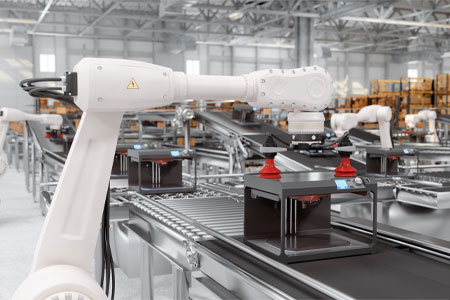
In factory automation (FA) and robotics, electric (electromagnetic) actuators and pneumatic actuators are used selectively based on the application.
Electric (electromagnetic) actuators, which offer high controllability, are used in processes where high precision is critical, such as robot joint drives and the precise positioning of machine tools. Meanwhile, pneumatic or hydraulic actuators are selected for scenarios such as press-fitting tasks, high-speed movement, transporting heavy objects, and clamping (securing) components, depending on the specific requirements.
Medical and Precision Equipment
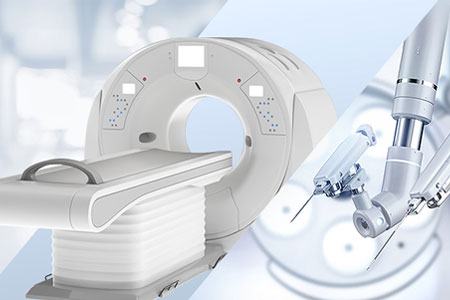
Medical and precision equipment strictly require high controllability and the ability to operate in clean environments. In this field, piezoelectric actuators and electric (electromagnetic) actuators are primarily utilized.
Piezoelectric actuators, known for their excellent responsiveness, are used for the precise movements of surgical robots, semiconductor manufacturing equipment requiring nanometer-level control, and inkjet printer heads. For mechanisms that precisely move relatively heavy loads, such as elevation control for patient lifts and table movement for MRI/CT scans, electric (electromagnetic) actuators are used due to their combination of excellent energy efficiency and high controllability.
Architecture and Housing

From massive construction sites to familiar residences, actuators are indispensable in the architecture and housing sector.
Hydraulic actuators, boasting high output, are adopted for construction machinery requiring massive power and for control systems such as aircraft flaps. In the housing field, electric (electromagnetic) actuators are used in smart home features like the automatic opening and closing of windows and emergency exits, contributing to energy savings, barrier-free accessibility, and improved safety.
5. MinebeaMitsumi's Actuator-Related Products
In the field of electric (electromagnetic) actuators, MinebeaMitsumi offers a product lineup that integrates our long-cultivated ultra-precision machining technologies with advanced electronics technologies.
"Stepping Motors" for High-Precision Control
Our stepping motors operate accurately in synchronization with pulse signals, greatly contributing to the precise positioning control of office automation (OA) equipment and industrial machinery.
"Resonant Devices (LRA)" Delivering Enriched Tactile Sensations
Our resonant devices enable precise vibration control and create a realistic operating feel, starting with haptics (tactile feedback) in smartphones.
We will propose the optimal solution tailored to your specific applications, so please feel free to consult with MinebeaMitsumi.
6. FAQ(Frequently Asked Questions)
What kind of device is an actuator?
What types of actuators are there, and what are their respective characteristics?
Utilizes motors and magnetic force. Features high-precision control, complex programming capabilities, and excellent energy efficiency.
Hydraulic:
Utilizes high-pressure oil. Generates massive force suitable for construction and heavy machinery.
Pneumatic:
Utilizes compressed air. Lightweight and fast, offering safe and easy handling even during overloads.
Piezoelectric:
Utilizes material deformation caused by voltage. Enables nanometer-level positioning for ultra-precise operations.
In what fields and applications are different actuators used?
Electric types for vehicle safety, comfort, and smart home features.
Industrial Machinery:
Electric for precise positioning; pneumatic/hydraulic for heavy transport and press-fitting.
Medical & Precision Equipment:
Piezoelectric and electric types for strict precision control.
Construction:
Hydraulic types for heavy machinery requiring massive power.
Contact Us
Please click the inquiry type below according to your question. Each product / sales representative will respond to you.


