
Closed-Loop Control
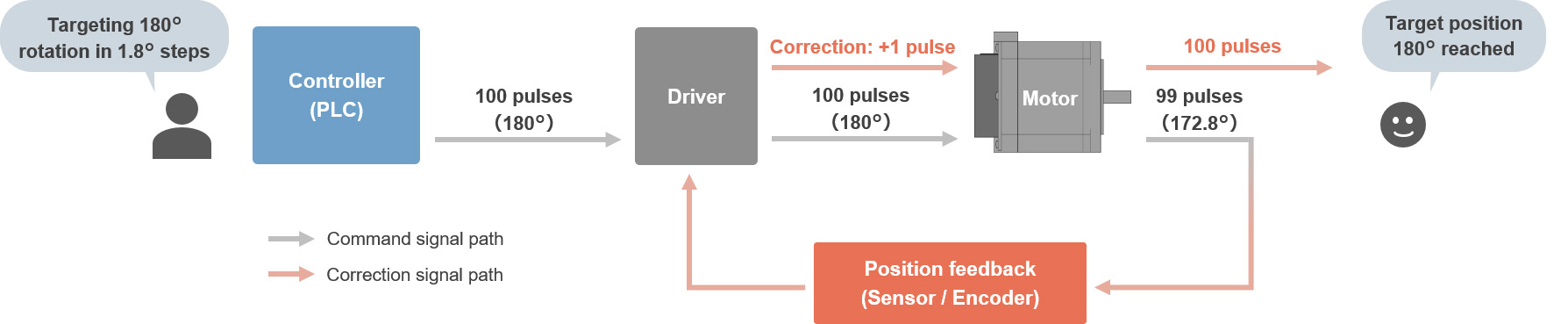
Closed-loop control is a control method that not only sends commands from a controller to a motor, but also monitors and feeds back actual motion, such as position and speed. Although adding feedback sensors and dedicated control circuits increases initial costs, the driver’s built-in logic automatically detects and corrects any deviation between command signals and actual movement.
Standard open-loop control can be converted to closed-loop control by attaching a rotary encoder to a stepping motor and pairing it with a feedback-compatible driver. For example, with a stepping motor that rotates 1.8° per pulse, when the controller commands a 180° rotation by sending 100 pulses, the sensor continuously monitors the actual rotation angle. If load conditions cause position deviation or step loss, the sensor instantly detects the error and automatically compensates for the missing pulses. Unlike open-loop control, which would proceed uncorrected, closed-loop control ensures accurate arrival at the target position (180°). The opposing method that sends signals unidirectionally is called “Open-Loop Control.“
-
-
CLOSED-LOOP CONTROL
A guide to comparing and selecting stepping motors with encoders. Read our article for key points, or download our flowchart-based selection guide to quickly find the right motor for your application.
Related Term
Related page
Alphabetical Search
Supprt & Contact
Please click the inquiry type below according to your question. Each product / sales representative will respond to you.


