
Difference Between Torque And Moment Of Inertia | Motor Unit Conversion Tool
Fundamentals of proper motor selection
Fundamentals of proper motor selection "Torque" and "moment of inertia" are key specifications in motor catalogs. Acting as the rotational equivalents of linear "force" and "mass," these two concepts are closely related. This page explains their differences and relationship using simulators and diagrams, and provides a unit conversion tool.
View the unit conversion table here. The formula for calculating motor torque is available here.
1. Practical unit conversion tool
Supported units include standard SI (N·m, kg·m²), gravitational (kg·cm), and imperial units (oz・in). Use this tool for quick conversions.
2. Summary: Difference between torque and moment of inertia
In short, torque represents the force driving rotation, while moment of inertia represents an object's resistance to that rotation.
This relationship mirrors the physics of linear acceleration. It adapts the fundamental principle of Force (F)= mass (m) × acceleration (a) to rotary motion. Just as a heavier vehicle requires more force to accelerate, an object with a higher moment of inertia requires greater torque to rotate rapidly.
Applying this concept to the F = m × a equation yields the following formula for rotational motion:
■ Comparison of linear and rotary motion
スクロールできます
| Motion type | Driving factor (Cause) | Resistance | Change in speed (Result) | Basic formula |
|---|---|---|---|---|
| Linear motion | Force (F) | Mass (m) | Acceleration (a) | F = m × a |
| Rotary motion | Torque (T) | Moment of inertia (I) | Angular acceleration (α) | T = I × α |
Torque and moment of inertia simulator
Adjust the sliders to alter the balance between torque and moment of inertia, and observe the effect on rotational momentum.
Control panel
Moment of inertia (I = mr² ): 0
Angular acceleration (α = T/I ): 0
Current rotational speed (ω ): 0
3. What is torque?
Torque refers to the rotational force that causes an object to turn.
It is measured in
newton-meters (N・m), representing the product of applied force (in newtons) and the distance from the axis of rotation (in meters). For example, 1N・m corresponds to the rotational force generated when applying a 1N perpendicular force (roughly equivalent to the gravity acting on a 100g mass) at a distance of 1 m from the axis of rotation. This relationship is expressed by the following equation:
*The distance from the axis of rotation is denoted by "r" because it represents the radius of the circular path swept by the rotating point.
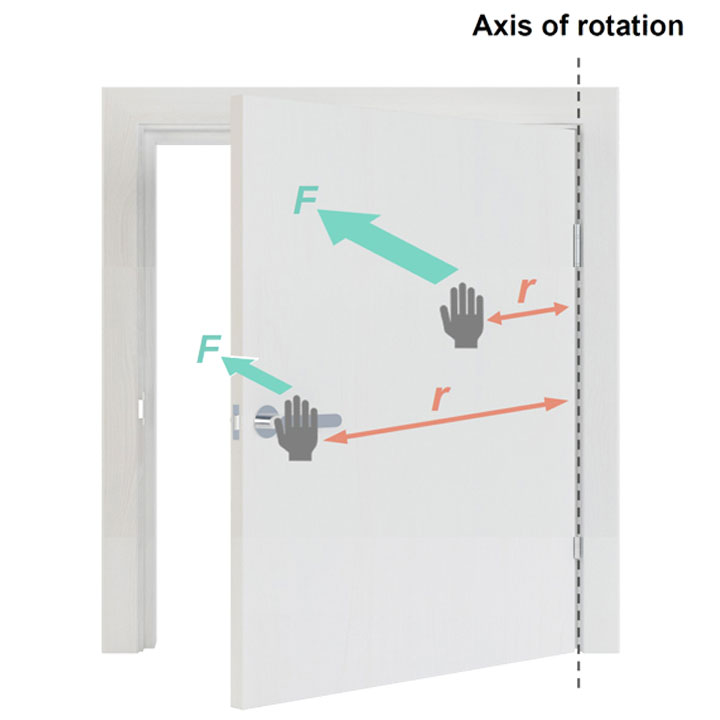
How to open a door with minimal force
Pushing near the hinges (the axis of rotation) requires significant effort, whereas pushing near the handle (farther away) allows the door to open with minimal force ( F ). This is because increasing the distance ( r ) generates greater torque (𝚻 ) reducing the required force.
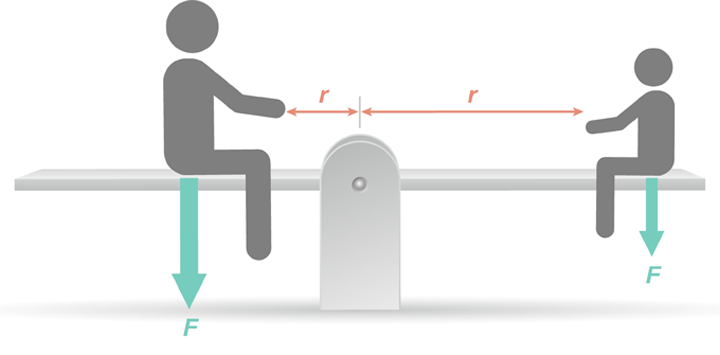
How people of different weights balance on a seesaw
A lighter person can balance against a heavier person by sitting farther from the fulcrum (axis of rotation). Increasing the distance ( r ) allows their smaller force ( F ) to generate torque (𝚻 ) equal to that of the heavier person.
4. What is moment of inertia?
Moment of inertia is a measure of an object's resistance to rotational changes (how difficult it is to initiate or stop rotation).
Rather than depending solely on total mass, it varies significantly based on how that mass is distributed relative to the axis of rotation. It is measured in kilogram-square meters (kg・m²), representing the product of mass (in kilograms) and the square of the distance from the axis of rotation (in meters squared). For instance, 1kg・m² corresponds to the rotational resistance of a 1kg mass located 1m from the axis of rotation. This relationship is expressed by the following equation:
👉 Design tip
Doubling the distance from the axis of rotation quadruples the moment of inertia (22 = 4). Consequently, when designing mechanisms such as robotic arms, mounting heavy components like motors close to the central axis significantly improves mechanical responsiveness.
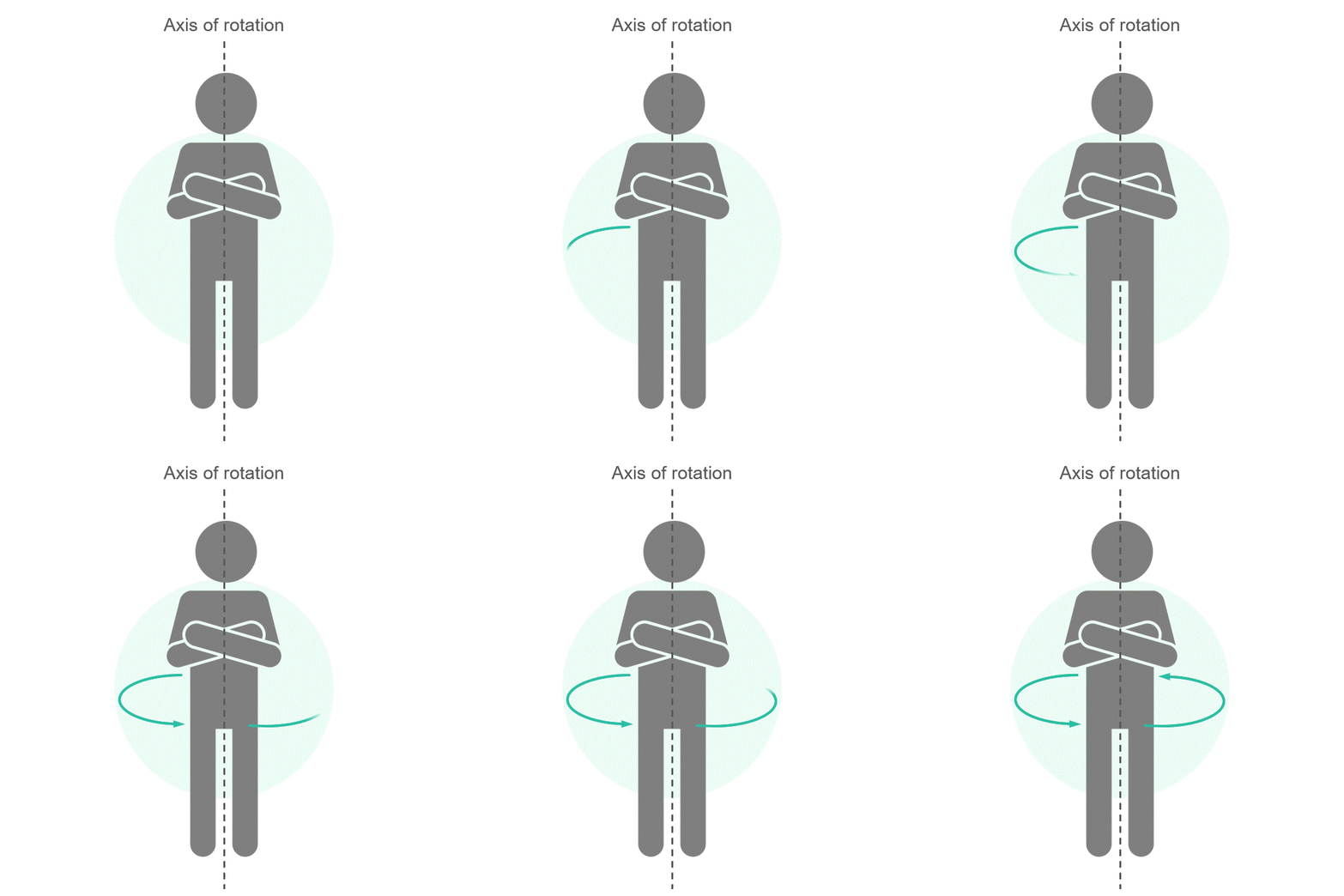
With arms extended
Mass is far from the axis of rotation
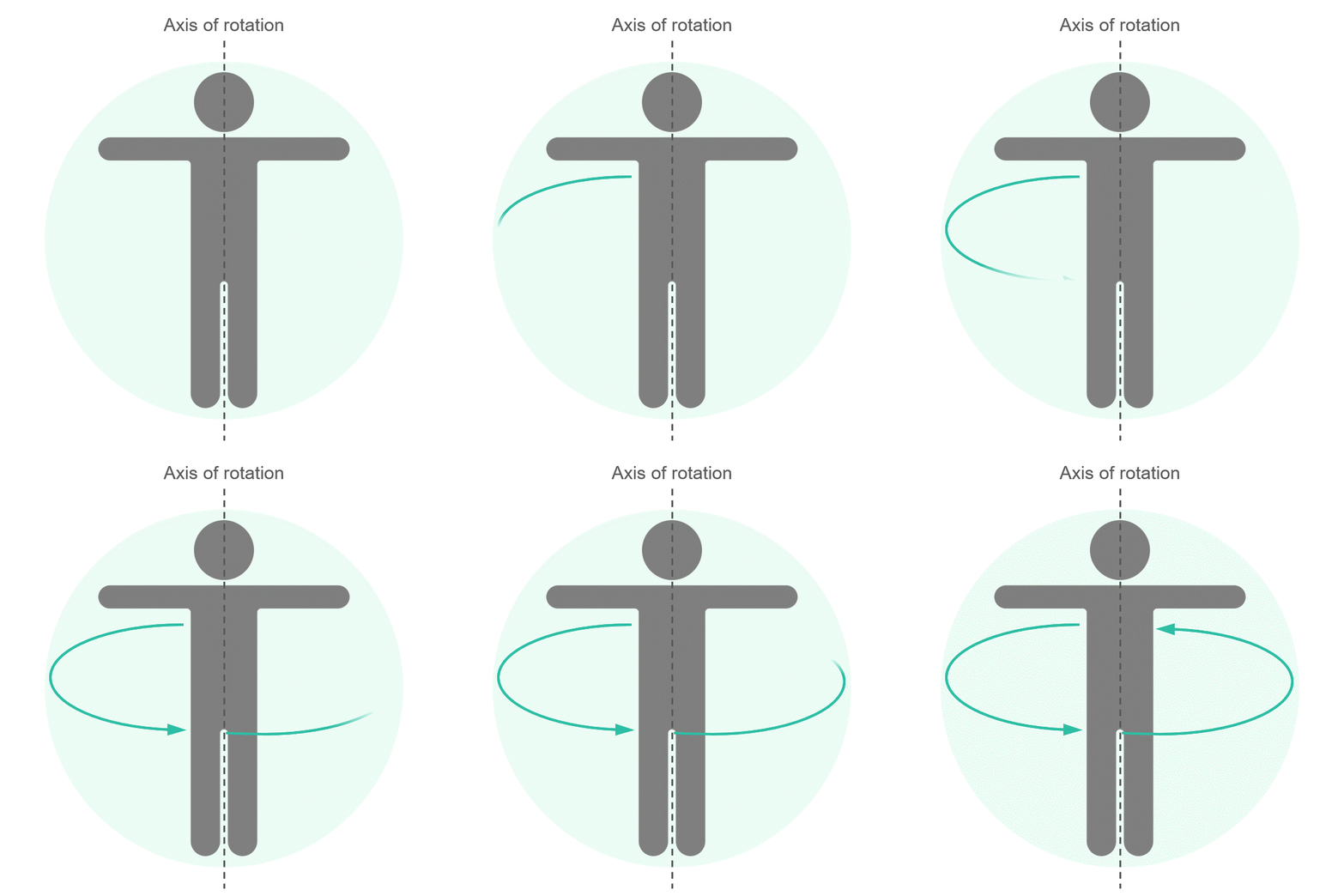
With arms tucked in
Mass is close to the axis of rotation
For motor catalogs and inquiries
Related Page
Contact Us
Please click the inquiry type below according to your question. Each product / sales representative will respond to you.


