
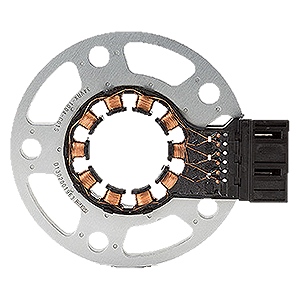
VR resolvers (variable reluctance resolvers) are angular displacement sensors that detect motor rotation angles and provide analog output signals. Featuring a simple structure without rotor windings or brushes, they offer excellent durability in harsh environments subject to heat, vibration, and dust. This robustness directly contributes to extended equipment service life and stable operation.
MinebeaMitsumi’s VR resolvers achieve highly accurate angle detection through advanced manufacturing techniques, maintaining copper wire winding precision to within half the specified tolerance.
To further enhance durability, TIG (tungsten inert gas) welding is used for wire connections instead of conventional soldering. During this process, the molten metal forms a spherical bead that encapsulates the copper wire, creating a highly resilient joint that minimizes the risk of vibration-induced wire breakage. This uniform bead shape also streamlines visual inspection; any joint defects, such as a deformed or collapsed bead, are easily identified during manufacturing. Ultimately, this ensures the consistent quality and reliability you need for your end products.
Applications
Automotive
EVs
Electric Power Steering (EPS)
Speedometers
Hybrid Vehicles
Electric Power Steering (EPS)
Integrated Starter Generator (ISG)
Brake-by-Wire (BBW)
Steer-by-Wire (SBW)
Valve Control
Resolvers Parts List
Click the arrow icon in the table below to switch from ascending to descending order.
Featured Products
Product Topics
Industry
FAQ
What are the key differences between brushless and VR resolvers, and how do I choose between them?
Deliver high accuracy for general servo applications, but require a longer axial length and higher structural complexity due to the internal rotary transformer.
Feature a rotor made solely of stacked magnetic steel laminations. Placing all windings on the stator enables a thinner, lighter profile and lower manufacturing costs, making VR resolvers the industry standard for space-constrained EV traction motors and high-rpm applications.
Please feel free to contact us if you need help selecting the right option.
What is the difference between resolvers and encoders?
Why are VR resolvers preferred for EV traction motors over optical or magnetic encoders?
What factors affect resolver position accuracy, and how can installation errors be minimized?
How are resolver output signals (SIN/COS) processed?
Contact Us
Please click the inquiry type below according to your question. Each product / sales representative will respond to you.


