

Fasteners are mechanical components—such as bolts, nuts, and screws—used to securely join and fasten assembly parts. They are optimized for demanding industrial applications requiring high heat and fatigue resistance, including aircraft engines, airframes, automobiles, rockets, and railway vehicles.
A key advantage is an integrated production system covering everything from cold and hot forging to machining, heat treatment, and surface treatment. By selecting materials like high-tensile steel, nickel alloys, or titanium alloys based on specific applications, these fasteners deliver consistent quality, high clamping force, and anti-galling performance even under severe thermal and mechanical loads.
Application
Aircraft
Helicopters
Automobiles
Railway vehicles
Ships
Rockets
BOLTS
Overview
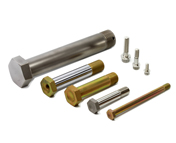
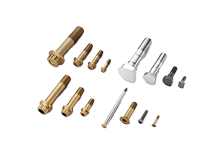
These are the most typical examples of fasteners used for assembling engines and fuselage panels.They are manufactured from a variety of materials in order to meet application requirements.Thus,for assemblies requiring high tensile strength and fatigue strength,high-tension (up to 260ksi) bolts are suitable;for applications involving high temperatures and corrosive conditions,nickel alloys and heat/corrosion-resistant steels are chosen;and if weight is critical,titanium alloys are employed.
NUTS
Overview
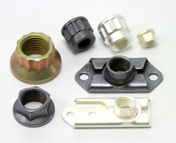
Various self-locking nuts are available-such as 6-point nuts,12-points nuts and floating nuts (one lug or two lug) .They are made of various alloys,as well as heat-resistant and corrosion-resistant steels.To prevent galling,molybdenum disulfide lubricant is used,and silver plating is applied if the nuts are to be exposed to high temperatures.
RECESS SCREWS
Overview
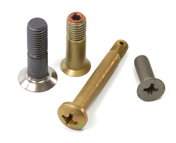
These bolts,which have a dovetail groove at the base of the head recess,play an important role in the high-torque fastening of fuselage exterior panels and other applications.
Industry
Contact Us
Please click the inquiry type below according to your question. Each product / sales representative will respond to you.


