
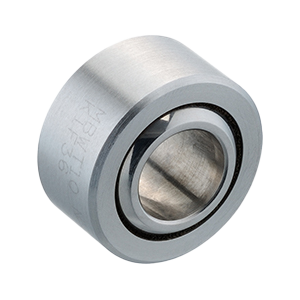
Spherical bearings are self aligning bearings used extensively on the driven parts in the aerospace, automobiles, railways and industrial machines. We offer distinctive products that will fit your needs, such as PTFE bearings that have a self-lubricating function, or metal to metal bearings that perform well under static and high load environment.
Please consult with our sales unit when designing for special purposes.
Applications
Aircraft
Helicopters
Automobiles
Railway Cars
Download
Related page
Please refer to the MinebeaMitsumi Aerospace website (English version only) for information on various certified products related to aircrafts.
Spherical bearings Parts List
Click the arrow icon in the table below to switch from ascending to descending order.
scroll
|
Series |
Unit |
Description |
Configuration |
Catalog |
|---|---|---|---|---|
| MBT, MBT-V | mm | Self Lubricating | Standard | Product Catalog |
| MBWT, MBWT-V | mm | Self Lubricating | Wide | Product Catalog |
| MBYT, MBYT-V | mm | Self Lubricating | High Misalignment | Product Catalog |
| SBT | mm | Self Lubricating | Standard | Product Catalog |
Industry
FAQ
What kind of bearing is a spherical bearing?
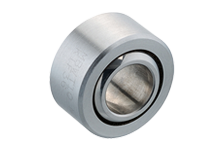
It is a self-aligning plain bearing where the outer surface of the inner ring and the inner surface of the outer ring meet at spherical sliding surfaces, allowing smooth rotation and oscillation while absorbing shaft misalignment and deflection.
It automatically aligns itself to avoid concentrated loads even in locations where mounting errors in the housing or shaft deflection due to load occur. Unlike ball or roller bearings, it supports loads across the entire sliding contact area, offering space savings and exceptionally high load capacity. It is widely adopted in drive joints for aircraft, railway vehicles, automobiles, industrial machinery, and more.
What is the difference between spherical bearings and ball bearings?
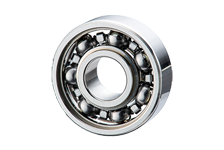
Spherical bearings are plain bearings designed for heavy loads and self-alignment through surface contact, whereas ball bearings use point contact and are suitable for high-speed rotation, making their applications distinct.
Because spherical bearings have a large contact area, they exhibit exceptionally strong resistance to impact loads and heavy loads. On the other hand, ball bearings utilize rolling friction, making them suitable for high-speed rotation, but they have a smaller tolerance for shaft misalignment. Spherical bearings are ideal for components that involve oscillatory motion or shaft inclination.
What are the advantages and features of the PTFE type (self-lubricating / liner type)?
By placing a PTFE liner between the sliding surfaces of the inner and outer rings, it achieves self-lubricating operation that eliminates the need for grease, providing a maintenance-free solution.
It is optimal for high-altitude or confined places where relubrication is difficult, as well as environments where oil or grease must be avoided, significantly reducing the labor and cost of periodic maintenance. Furthermore, due to its excellent initial conformability, low coefficient of friction, and ability to withstand stable dynamic loads, it is widely used in aerospace applications.
Contact Us
Please click the inquiry type below according to your question. Each product / sales representative will respond to you.


