
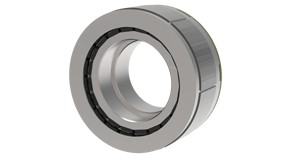
Frameless brushless DC motors are a lightweight, compact solution for applications requiring low inertia, high efficiency and high torque density such as robotics and automation. These motors offer unique design versatility and are easy to integrate into a wide range of applications. Replacing heavy, less efficient hydraulic systems with frameless brushless DC motors can result in lower operating and maintenance costs.
MinebeaMitsumi's frameless brushless DC motors are supplied as a kit with both rotor and stator, eliminating the time and effort to select them separately.
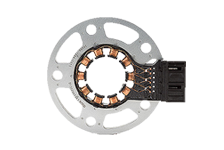
*The stator shown may differ from the actual product.
Applications
Industrial Robots
Robotic Surgery
Respiratory Equipment
Humanoid Robots
Material Handling Robots
Download
Frameless brushless DC motor Parts List
Click the arrow icon in the table below to switch from ascending to descending order.
scroll
|
Parts |
Outer Diameter |
Motor Length |
Rated Voltage |
No load speed |
Rated Speed |
Rated torque |
Current at Rated Speed |
Efficiency at Duty Point |
|
|---|---|---|---|---|---|---|---|---|---|
| BLDC50 | 50 | 27.68 | 48 | 4500 | 3850 | 391 | 3.70 | 86 | |
| BLDC85 | 85 | 44.28 | 48 | 3750 | 3530 | 841 | 7.40 | 92 | |
| BLDC130 | 130 | 48.99 | 48 | 2260 | 1950 | 2020 | 10.50 | 92 |
Featured Products
Product Topics
Industry
FAQ
How much longer is the lifespan of a brushless DC motor compared to a brushed DC motor?
It is typically over 10 times longer, depending on operating conditions and brush materials.
While a brushed motor's lifespan is limited by brush/commutator friction and electrical spark wear, a brushless motor's lifespan is determined by bearing grease degradation and electronic circuit longevity. Brushed motors average 200 to 1,000 hours, whereas brushless motors can last for several thousand hours or more.
What are the disadvantages of brushless DC motors?
The primary disadvantages are higher upfront costs compared to brushed DC motors, and the need for a dedicated driver (drive circuit).
Brushless DC motors cannot operate simply by connecting a power supply directly to them. Because an IC and PCB are required to control current switching, the initial cost is higher than that of brushed DC motors.
Why do brushless DC motors require a driver circuit?
To precisely switch the direction of the coil current in sync with the rotor's position.
Unlike brushed DC motors, they lack mechanical contacts that automatically switch the current. An electronic circuit must perform this function to maintain motor rotation.
How is the rotation speed of a brushless DC motor controlled?
The rotation speed is controlled by finely switching the timing of the electrical current.
Specifically, increasing the voltage results in higher speeds, and decreasing it results in lower speeds. PWM and VSP control are the primary methods used for this speed adjustment.
What are the specific applications for brushless DC motors?
They are widely used in drones, air conditioners, refrigerator compressors, cordless vacuum cleaners, and electric vehicle (EV) drive units.
Because they lack wearing parts (brushes), they feature long service life, quiet operation, and high efficiency. These characteristics make them an essential power source for products requiring these three features.
Contact Us
Please click the inquiry type below according to your question. Each product / sales representative will respond to you.


