
- Hybrid stepping motors
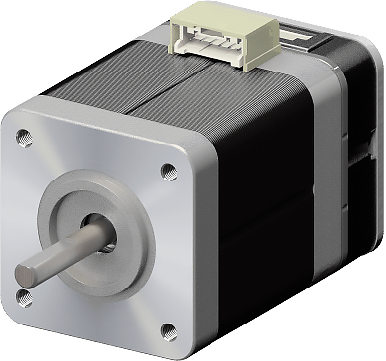
Monitor stalls by adding position detection to stepping motors
Case study
Stepping motors with position detection
Monitor stalls by adding position detection
to stepping motors.
Problem
Need to monitor stepping motor stalls.
Solution
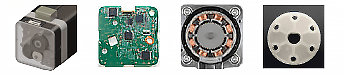
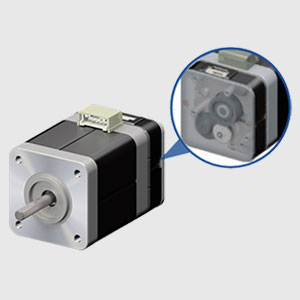
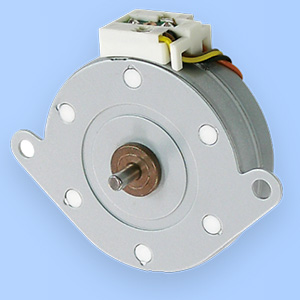
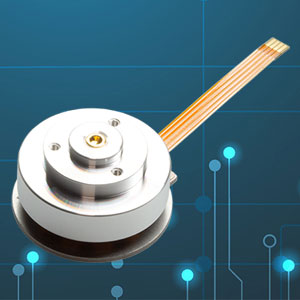
The issue was resolved by selecting the optimal stepping motor with position detection for the specific conditions, choosing from Hall IC sensor, optical/magnetic encoder, resolver, and battery-less absolute encoder types.
Benefits
- Enabled stall monitoring.
- Allowed selection of the optimal product from multiple types to suit the installation environment.
- Provided a choice of various detection angles.
Stepping motor stalls
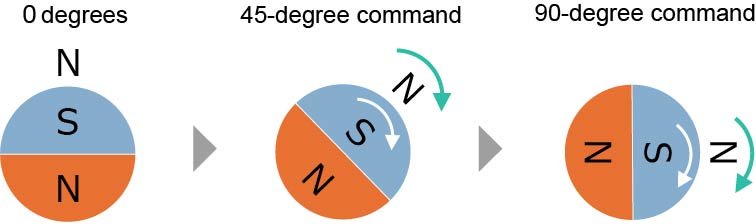
Stepping motors rotate at a specific angle corresponding to the number of input pulses. While their simple open-loop structure is an advantage for ease of use, unexpected conditions can cause the motor to lose synchronization with the input pulse signal. This results in a "stall," where rotation stops.
●Normal operation
●Stall (rotor fails to track the rotating magnetic field)
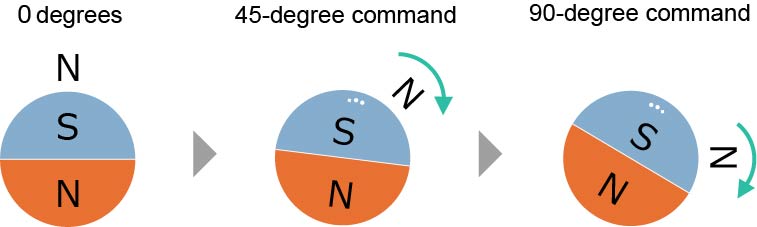
Causes range from sudden speed changes to increased loads. To detect these abnormalities and prevent stalls, some motors feature position feedback control. MinebeaMitsumi offers a lineup of four such types.
Hall IC sensor type
This type utilizes a Hall effect sensor, a semiconductor device that detects magnetic field changes. It determines position by sensing magnetic variations as the motor's rotor poles pass the Hall IC. Although its resolution is lower than that of encoders or resolvers, it is relatively inexpensive, making it an advantageous choice for applications that do not require detecting minute position deviations.
View Hall IC sensor type product pageEncoder type
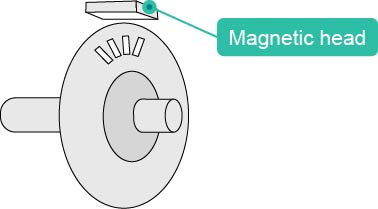
Equipped with an optical or magnetic rotary encoder, this type can detect position and speed, including rotational speed, direction, and angle.
Optical encoders utilize a code wheel with slits attached to the motor shaft. They operate by emitting LED light and detecting the encoder's status via light reflection. The code wheel generates optical pulses, which are converted into electrical signals to provide rotational position data. A key advantage is their high resistance to surrounding magnetic fields.
Magnetic encoders detect changes in magnetic fields to determine the rotation angle. Although they require consideration of the ambient magnetic environment, they offer a cost advantage compared to optical types.
View encoder type product page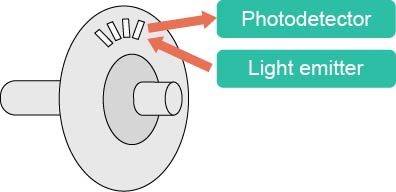
Battery-less absolute encoder type
Featuring a high resolution of 4,000 cpr, this type enables highly accurate position detection. Applying the principle of an analog clock, it retains the current position without a backup power supply even when the encoder power is turned off. Furthermore, because operation can resume without homing after an emergency stop, it eliminates the need for origin and limit sensors while contributing to shorter cycle times.
View battery-less absolute encoder type product page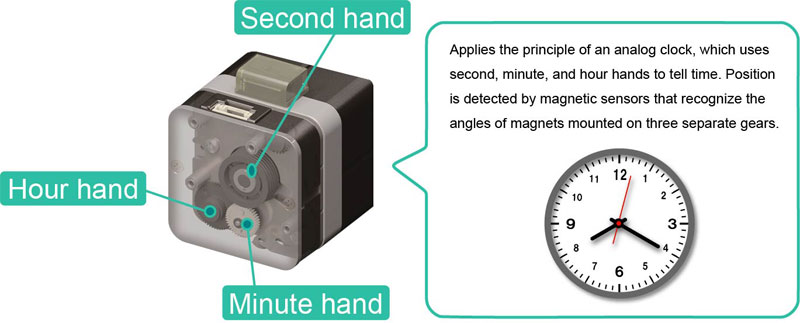
Resolver type
This type features an extremely high resolution of 200,000 P/R. Its simple structure makes it highly resistant to heat, dust, shock, and vibration, ensuring highly stable and precise motor operation even in harsh environments.
View resolver (angle sensor) type product pageMinebeaMitsumi 4-product comparison table
スクロールできます
|
|
Hall IC sensor type |
Encoder type |
Battery-less absolute |
Resolver type |
|---|---|---|---|---|
| Detection principle | Magnetic field changes | Optical encoder / Magnetic encoder |
Magnetic absolute encoder |
Electromagnetic induction |
| Detection accuracy | Low | High | High | Very high |
| Output data | Basic position data from magnetic pole passage (ON/OFF, etc.) |
High-precision position and speed data |
High-precision position and speed data |
Continuous angle data
(analog signal) |
| Signal format | Pulse | Line driver | Line driver | Analog AC signal |
| Environmental resistance | Standard | Standard | Standard | Very high |
| Position data retention | No | No | Yes | No |
| Cost | ◎ | ○ | △ | △ |
| Main applications |
Transport equipment, vending machines, simple robots, etc. |
Semiconductor manufacturing equipment, medical devices, inspection equipment, robot joints, etc. |
(In addition to encoder applications) Equipment in environments with frequent power outages, etc. |
Industrial robots, EV/HEV, machine tools, aircraft, heavy machinery, industrial sewing machines, etc. |
To address the need to monitor stepping motor stalls, you can select the optimal product from the table above to match your specific operating environment. We also accommodate small-lot orders and customizations. Please feel free to consult with us.
Please feel free to contact us regarding small-lot orders and customizations.
Related page
Rotary components case studies
Contact Us
Please click the inquiry type below according to your question. Each product / sales representative will respond to you.


