
Functions / Technologies
We have compiled frequently asked questions from our customers and their answers.
Please use this if you cannot find the information you are looking for or need more detailed information.
Product Category
-
*Search example : Stator Ass'y, Rated Torque
Bearings
Miniature & small ball bearings
QHow can I find the grade of the ball bearing from P/N information?
AEngineering Information
QHow much is the rotation torque range?
AEngineering Information
QI would like to know maximum axial load of the ball bearing.
A
QI would like to know radial, axial and angle clearance of the ball bearings.
A
QI would like to know the tolerance of the shaft and housing in the case of tight fitting.
AEngineering Information
QI would like to know the difference of internal design "X2", "X3" etc…
A
QI would like to know the weight of ball bearing.
A
QI would like to know chemical, acid resistant ball bearings.
A
QI would like to know useful temperature range of ball bearings.
A
QI would like to know about low-outgas grease information.
A We have a various grease of your requesting cleanliness.
We can recommend the best low-outgas grease for your requesting cleanliness and applications.
QI would like to know the difference of the P/N "608ZZ" and "R-2280HH".
A
Rod End Bearings
QWhat is the difference between spherical bearings and rod end bearings?
A
The main difference is whether a threaded body (with internal or external threads) is integrated with the spherical bearing itself.
Spherical bearings are standalone bearing units that are press-fitted or staked into a machine housing. On the other hand, rod end bearings feature a spherical bearing integrated into a threaded rod body. This design allows them to be directly screwed into linkages, cylinder rod ends, or connecting sections, enabling easy length adjustment during installation.
QWhat are the technical strengths of MinebeaMitsumi rod end bearings?
A
Our core strengths lie in high dimensional accuracy achieved through ultra-precision machining technology, alongside high-quality, high-reliability PTFE liner technology that meets aerospace standards.
Thanks to strict quality control and the proven durability of our self-lubricating liners developed over many years, our bearings deliver stable low-friction performance and long service life even under harsh operating environments.
QWhat is the difference between 3-piece and 2-piece structure rod end bearings?
A
A 3-piece structure consists of a body, race, and ball, offering high precision and long service life, whereas a 2-piece structure features a simpler construction where the ball is assembled directly into the body.
The 3-piece design is widely used in industrial machinery and aircraft requiring high-precision movement and heavy-load capacity, while the 2-piece design is typically used for applications prioritizing cost efficiency.
Spherical bearings
QWhat kind of bearing is a spherical bearing?
A
It is a self-aligning plain bearing where the outer surface of the inner ring and the inner surface of the outer ring meet at spherical sliding surfaces, allowing smooth rotation and oscillation while absorbing shaft misalignment and deflection.
It automatically aligns itself to avoid concentrated loads even in locations where mounting errors in the housing or shaft deflection due to load occur. Unlike ball or roller bearings, it supports loads across the entire sliding contact area, offering space savings and exceptionally high load capacity. It is widely adopted in drive joints for aircraft, railway vehicles, automobiles, industrial machinery, and more.
QWhat is the difference between spherical bearings and ball bearings?
A
Spherical bearings are plain bearings designed for heavy loads and self-alignment through surface contact, whereas ball bearings use point contact and are suitable for high-speed rotation, making their applications distinct.
Because spherical bearings have a large contact area, they exhibit exceptionally strong resistance to impact loads and heavy loads. On the other hand, ball bearings utilize rolling friction, making them suitable for high-speed rotation, but they have a smaller tolerance for shaft misalignment. Spherical bearings are ideal for components that involve oscillatory motion or shaft inclination.
QWhat are the advantages and features of the PTFE type (self-lubricating / liner type)?
A
By placing a PTFE liner between the sliding surfaces of the inner and outer rings, it achieves self-lubricating operation that eliminates the need for grease, providing a maintenance-free solution.
It is optimal for high-altitude or confined places where relubrication is difficult, as well as environments where oil or grease must be avoided, significantly reducing the labor and cost of periodic maintenance. Furthermore, due to its excellent initial conformability, low coefficient of friction, and ability to withstand stable dynamic loads, it is widely used in aerospace applications.
Bushings
QWhat type of bearing is a bushing (sleeve bearing/plain bearing)?
A
A bushing is a bearing that supports loads and achieves smooth motion through direct sliding contact between the shaft and the bearing surface.
Because it utilizes sliding motion, it excels in low-speed, high-load environments as well as applications subject to vibration and shock. A wide variety of types are available—including maintenance-free self-lubricating types and high-precision metal types—and they are used in a broad range of industries, from automotive and industrial machinery to aerospace.
QWhat is the difference between a bushing (sleeve bearing/plain bearing) and a rolling element bearing (ball bearing)?
A
Rolling element bearings perform rolling motion through point or line contact using balls or rollers, whereas bushings perform sliding motion through surface contact.
While ball bearings feature low friction coefficients and excel in high-speed rotation, bushings offer superior shock resistance and high-load capacity due to their larger contact surface area; their simple component structure also makes them ideal for lightweight designs and installation in tight spaces.
QWhat are the technical strengths of MinebeaMitsumi bushings?
A
Our core strength lies in our high-reliability, long-life designs that integrate ultra-precision machining technology with advanced materials engineering.
Leveraging dimensional precision cultivated through years of bearing manufacturing expertise alongside aerospace-compliant PTFE liners, we support the global aerospace and defense industries.
Precision Machined Components
Precision mechanical components
QWhat is PMC?
A
Fastener
QWhom should I ask about technical question?
A Please contact your sales representative or submit your query via our Contact form.
QPlease tell me size variation of fastener.
A We will consider the size of the production of customer requirements. Please contact us for details.
QWhat kind of raw material is used for your products?
A We manufacture parts for a variety of materials including aluminum alloys , titanium alloys , alloy steels, etc. I have experience in a wide variety of materials In addition to this, more details, please contact us.
QWhat kind of surface treatment can you process?
A Minebea can perform virtually all of the surface treatment required for fasteners and mechanical parts, such as cadmium plating, silver plating, hard chrome plating, zinc plating, and others. Please contact us for details.
QWhat kind of heat treatment can you process?
A In order to ensure the product characteristics required by consensus or customers' standards , Minebea has a full line-up of heat treatment equipment, including vacuum furnaces, continuous-type furnaces, and shaker hearth furnaces for titanium alloy fasteners . Please contact us for details.
Wavy Nozzle
QWhat are the key features and advantages of the Wavy Nozzle compared to conventional fixed air nozzles?
A
The main advantage is that the nozzle's oscillating motion allows it to discharge coolant or air directly to the optimal position for each tool and machining process, effectively removing chips.
With conventional fixed nozzles, manual adjustments by operators were required, making it difficult to achieve consistent setups. The Wavy Nozzle automatically sprays coolant or air to pre-set positions through its oscillating movement, efficiently clearing chips and significantly improving overall machining efficiency.
QWhere are the control boards stored?
A The control board is stored inside the machine control panel box.
QIs it possible to set the operation mode without a controller?
A A controller is required to set the operation mode. It can be set with a wired controller or a wireless controller using an iOS device.
QIs it possible to set the operation mode from NC?
A No. A controller (wired or wireless connection) is required.
QCan a non-NC machine use Wavy Nozzle?
A Yes, it can also be controlled by a Sequencer.
QIs there any influence of noise caused by other devices in the factory when connected via Bluetooth?
A Normally, Bluetooth can communicate over a distance of 20 meters (65 ft), but the it has been verified to be able to communicate if it is 5 meters (16 ft) in a factory noise environment.
QIs there a standard lineup of attachments (mounting jigs)?
A A standard installation kit is currently available only for FANUC ROBODRILL. However, for other machines that have a track record of installation with MinebeaMitsumi, jigs have been made into drawings and it is possible to buy mounting jigs and obtain drawings.
We can sell mounting jigs and provide drawings.
QCan Wavy Nozzle use for Semi-dry cut using oil mist?
A Yes. It can be used.
QWhat is the maximum viscosity of the cutting-oil?
A We have experience of up to 40mm2/s viscosity.
QWhat kind of coolant can be used?
A Wavy Nozzle can be used by oil based coolant WITHOUT chlorine or active sulfer and water based coolant WITH mineral oil.
If you want to use other kind of oil, please inquire from the form.
QCan Wavy Nozzle eject air instead of coolant?
A Currently there are two types of nozzles with dia. 3mm and dia. 5mm holes. Since the nozzle is attached by a 1/4 tapered screw, it can be replaced with a commercial nozzle.
QCan Wavy Nozzle use any other liquids besides coolant oil? For example, cleaning solution.
A Use with liquids other than coolant is not covered by the warranty. However, since some liquids may be usable, please consult with the manufacturer and model number of the liquid.
QIs the M-code signal used to operate Wavy Nozzle a "shot signal" or "Latch Signal"?
A Latch signal is required.
QIs it possible to change the cable between the ejection unit and the control board to longer cable?
A No.Operation is guaranteed with the product cable length of 6 meters (20ft). If the cable is extended, it cannot be guaranteed. If the length is not enough, divide the control board and extend it with a cable.
QThere are 5 M-code inputs with the standard setting. How can it be expanded up to 31 settings?
A By changing M-Code process mode to "5-BIT", the 31 settings can be called up by combination of 5 codes on a single input line.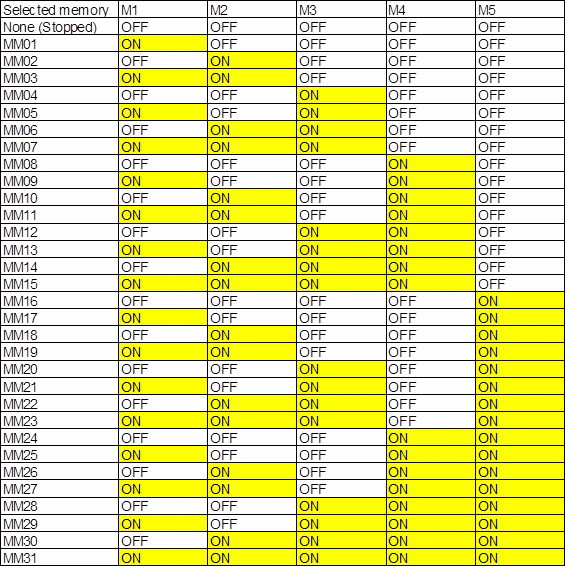
QKICK mode has a function of oil ejection of one-direction. Does Wavy Nozzle have a built-in valve?
A No, Wavy Nozzle does not have a valve itself, but it can control the ON/OFF valve signal in the machine.
QHow are air and oil connected?
A An existing nozzle(s) is typically removed and replaced with a Wavy Nozzle unit. An existing or new coolant line would need to attach to the Wavy Nozzle. An adapter may be necessary.
QHow to wire Nozzle cable?
A Nozzle cable is routed using existing holes inside machining area.
QWhat is the oil inlet of the ejection unit?
A Rc3/8 female (BSPT)
QCan discharge pressure be adjusted?
A No. There is no valve or pressure-increasing function inside the Wavy Nozzle, and the pressure of the pump dominates the discharge pressure because it is just a flow path.
QIs there any limitations regarding the mounting direction?
A There is no limit, as any position/orientation will not affect its ability to operate.
QCan we buy a mounting jig?
A Standard mounting jigs can be supplied as drawings. They can also be sold (extra cost).
QCan we obtain CAD files to consider installation?
A Yes, CAD files can be provided.
QIs it necessary to connect the controller even during operation?
A No. The controller is needed only for setting up the operation mode. Once the setting is complete, there is no problem in operation, even if the controller is removed.
QIs there an alarm signal output that informs the failure of Wavy Nozzle to the machine?
A Yes. An alarm output terminal is provided on the control board. You can respond by connecting the wiring from the control board to the machine and adding it as an alarm condition or a stop condition. Connection and NC setting is needed.
QIs there the function that notifies the Wavy Nozzle when the machine stops or has an alarm signal?
A Yes. There is an External alarm input terminal in the control board.
QIs there a case where all coolant is processed only with the Wavy Nozzle?
A Yes. But, depending on the situation not all processes can be covered with just a single Wavy Nozzle. In that case, please use a fixed nozzle together.
QAre there any variations of the nozzle available?
A Currently there are two types of nozzles with dia. 3mm and dia. 5mm holes. Since the nozzle is attached by a 1/4 tapered screw, it can be replaced with a commercial nozzle.
QDo chips clog inside Wavy Nozzle?
A If chips larger than the nozzle diameter enter, they will clog. If clogged, remove the nozzle and blow with air to remove chips.
QDoes vibration of the nozzle's movement affect accuracy?
A From our experience in precision machining at MinebeaMitsumi, it is not a problem as long as the Wavy Nozzle unit is mounted tightly.
QHow to troubleshoot error codes?
A Please check the diagnostic chart.
QWhat is the solution when coolant pressure drops?
A Please clean the filter and coolant tank.
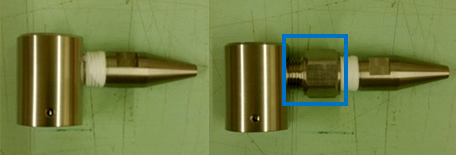
QCoolant stream is scattered and diffused, and is difficult to spray at the desired cutting point.
A Attach a flow straightening adapter to the nozzle.
QWhat is the countermeasure for the limited installation space that prevents injection at the cutting point?
A Install a variable angle nozzle. It increases the range of injection positions.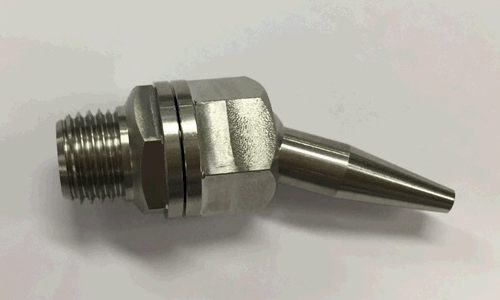
QWhat is the difference from the high pressure coolant system?
A High-pressure coolant equipment forcibly breaks chips with high-pressure cutting oil injection of 10 to 20 MPa. The Wavy Nozzle allows the chips to extend and flow in one direction. The chips are not necessarily broken. In the following cases, try using a Wavy Nozzle:
Rotary Components
Stepping motors
QWhat are the advantages and disadvantages of stepping motors?
A
QWhat is a stall, and why does it occur?
A
QWhat is the difference between 2-phase and 5-phase stepping motors?
A
QWhat is needed to operate a stepping motor?
A
QWhat is the lifespan of a stepping motor?
A
Hybrid stepping motors
QWhat are the differences between Permanent Magnet (PM) stepping motors and hybrid types?
A Hybrid stepping motors feature finer step angles, providing higher resolution and greater torque output than PM types.
While PM types have a simple structure and are low-cost, hybrid models incorporate a gear-toothed magnetic core and a permanent magnet in the rotor. This design makes them highly suitable for industrial equipment requiring precise positioning and high power output.
QWhat is the lifespan of a hybrid stepping motor? Does it require regular maintenance?
A
The motor's lifespan is essentially determined by its internal bearings. Since there are no wearing parts like brushes, they are virtually maintenance-free over long periods.
Under normal conditions, they boast a lifespan of tens of thousands of hours. However, excessively high ambient temperatures or applying radial (lateral) or thrust (axial) loads exceeding specifications will accelerate bearing wear. Designing your system within the tolerances specified in the data sheet is crucial for maximizing service life.
QHow do they differ from servo motors, and which should I choose?
A
The primary advantages of stepping motors are the elimination of complex setups like gain tuning, combined with high low-speed torque and strong holding power at a standstill.
Servo motors are preferable when high-speed operation or rapid response to sudden load changes is critical. Conversely, hybrid stepping motors are recommended when exact positional holding is required or when implementing simple, cost-effective open-loop control.
PM stepping motors
QHow can I achieve higher torque with a PM stepping motor?
A
To achieve higher torque, consider models equipped with a gearbox, such as planetary gears, or types utilizing strong neodymium magnets.
Gearbox-equipped models can output significant torque depending on the reduction ratio. Additionally, high-speed types combining a bonded neodymium magnet and a silicon steel stator deliver high torque and responsiveness despite their compact size.
QWhy can PM stepping motors be designed so thin?
A
Their simple structure allows for a shorter axial length.
While hybrid stepping motors feature a complex three-dimensional structure sandwiching a magnet between two gear-shaped iron cores, PM types consist of a cylindrical magnet and a sheet metal frame. This facilitates a thinner profile, and we offer a lineup of thin models under 15 mm. For compact motors with an outer diameter of 10 mm or less, we also offer products under 5 mm in length.
QWhich is better for a PM stepping motor: unipolar or bipolar?
A
Bipolar drive is generally recommended because of its superior torque efficiency, delivering the required force in a smaller footprint.
While unipolar circuits are simpler to implement, they are less efficient as they only energize half of the coil at a time. In contrast, bipolar drives utilize the entire coil, generating substantial torque even with limited battery voltage or compact motor sizes.
Hybrid stepping motor drivers and driver-integrated motors
QWhat is the origin of the name "cX-stepper" ?
A
The name "cX-stepper" originates from the acronym of our proprietary control technology enabling diverse motion control.
Specifically, it stands for "Complete motion control with 'X-tec' stepper drive technology."
QAre there other motors compatible with the cX-stepper driver besides those with absolute encoders?
A
We plan to gradually expand compatibility to include motors with electromagnetic brakes and gearheads.
Please contact us for detailed schedules and specifications.
Brush motors
QWhere are brushed DC motors used in multi-function printers (MFPs)?
A They power paper feeds, move ink cartridges and scanner heads, and operate trays. They are ideal for applications requiring simple unidirectional or reciprocating motion.
QWhat are the advantages of choosing a brushed DC motor over a brushless one?
A The primary advantage is its simple configuration, which requires no motor driver. They operate simply by connecting them to a DC power supply, and speed is easily controlled by varying the voltage via PWM. This reduces costs and saves PCB space. As long as they meet your required lifespan, brushed DC motors are the more cost-effective choice.
QHow can the lifespan of a brushed DC motor be extended?
A Effective measures include operating within rated limits, providing rest periods, and adding capacitors. Fundamentally, you must adhere to specifications by avoiding excessive loads and overcurrent. Adequate rest periods prevent overheating, while adding capacitors absorbs sparks that degrade the contacts, ultimately extending the motor's life.
QHow can I reverse the rotation direction of a brushed DC motor?
A Simply swap the positive (+) and negative (-) terminals (polarity reversal). The ability to change direction without complex electronic circuits is a key advantage.
QCan a brushed DC motor be run directly from a household AC outlet?
A No. As the name implies, they operate on direct current (DC). You must convert alternating current (AC) to DC using an AC adapter or similar device before connection.
Brushless motors
QHow much longer is the lifespan of a brushless DC motor compared to a brushed DC motor?
A It is typically over 10 times longer, depending on operating conditions and brush materials. While a brushed motor's lifespan is limited by brush/commutator friction and electrical spark wear, a brushless motor's lifespan is determined by bearing grease degradation and electronic circuit longevity. Brushed motors average 200 to 1,000 hours, whereas brushless motors can last for several thousand hours or more.
QWhat are the disadvantages of brushless DC motors?
A The primary disadvantages are higher upfront costs compared to brushed DC motors, and the need for a dedicated driver (drive circuit). Brushless DC motors cannot operate simply by connecting a power supply directly to them. Because an IC and PCB are required to control current switching, the initial cost is higher than that of brushed DC motors.
QWhy do brushless DC motors require a driver circuit?
A To precisely switch the direction of the coil current in sync with the rotor's position. Unlike brushed DC motors, they lack mechanical contacts that automatically switch the current. An electronic circuit must perform this function to maintain motor rotation.
QHow is the rotation speed of a brushless DC motor controlled?
A The rotation speed is controlled by finely switching the timing of the electrical current. Specifically, increasing the voltage results in higher speeds, and decreasing it results in lower speeds. PWM and VSP control are the primary methods used for this speed adjustment.
QWhat are the specific applications for brushless DC motors?
A They are widely used in drones, air conditioners, refrigerator compressors, cordless vacuum cleaners, and electric vehicle (EV) drive units. Because they lack wearing parts (brushes), they feature long service life, quiet operation, and high efficiency. These characteristics make them an essential power source for products requiring these three features.
Brushless DC Drone Motors
QWhat is "cogging" in motors?
A
It is the torque ripple (a notchy resistance) caused by internal magnetic forces when the motor shaft rotates.
In brushless DC (BLDC) motors, cogging torque is a major source of mechanical vibration and noise. To suppress vibration transmission to onboard equipment and ensure smooth rotation and quiet operation, it is important to select a motor with low cogging torque. MinebeaMitsumi products minimize cogging torque to deliver smooth rotation.
QHow should I select a motor based on total drone weight and payload?
A
We recommend selecting a motor where hovering requires approximately 40% to 50% of maximum thrust.
Maintaining this thrust margin provides the power required for attitude control and rapid ascents during gusts. It also keeps motor heat and battery consumption at optimal levels to ensure stable flight.
QWhat are the main factors affecting motor lifespan?
A
The main factors are physical wear and corrosion of the internal bearings, and thermal degradation of the coils due to overload.
For industrial drones that frequently operate outdoors, bearing degradation from dust and salt damage significantly shortens motor life. MinebeaMitsumi drone motors ensure long-term stability by maintaining appropriate thrust margins to reduce heat, utilizing rust-resistant Giga Protection® bearings, and applying an energy-efficient magnetic circuit.
Vacuum pump (under development)
QAre there any orientation restrictions for installing the pump (e.g., vertical or horizontal)?
A
There are no specific restrictions on the installation orientation. It can be mounted
vertically, horizontally, or upside down to fit the available integration area.
Note: Ensure that the tubing does not kink during routing and that the pump is properly
secured to prevent vibration from affecting other precision components.
QAre there performance impacts when using the pump at high altitudes?
A
Yes. Because atmospheric pressure decreases at higher altitudes, the achievable vacuum
pressure (absolute pressure) and effective flow rate will be lower than at sea level.
Since vacuum pump performance is relative to ambient atmospheric pressure, please account
for this performance reduction and set up higher safety standards if you plan to use the
pump at altitudes above 1,000m.
Resolvers
QWhat are the key differences between brushless and VR resolvers, and how do I choose between them?
A
Deliver high accuracy for general servo applications, but require a longer axial length and higher structural complexity due to the internal rotary transformer.
Feature a rotor made solely of stacked magnetic steel laminations. Placing all windings on the stator enables a thinner, lighter profile and lower manufacturing costs, making VR resolvers the industry standard for space-constrained EV traction motors and high-rpm applications.
Please feel free to contact us if you need help selecting the right option.
QWhat is the difference between resolvers and encoders?
A
QWhy are VR resolvers preferred for EV traction motors over optical or magnetic encoders?
A
QHow are resolver output signals (SIN/COS) processed?
A
FDB motors
QWhat is the lifespan of an FDB motor?
A
As a reference, the expected lifespan is approximately 40,000 hours at an ambient temperature of 70°C at rated speed. Please note that actual lifespan varies depending on operating temperatures (which affect the oil evaporation rate).
Because FDBs operate completely contact-free, mechanical wear does not occur during rated operation. Therefore, the primary factors determining lifespan are the frequency of start/stop cycles and oil depletion due to evaporation. Generally, higher operating temperatures accelerate this evaporation, meaning the actual lifespan will depend on the specific operating environment.
QWhat key technical specifications should be confirmed when selecting an FDB motor?
A
The primary specifications to verify are rotational speed, rotation direction, applied load (rotating body), and operating environment (temperature, required lifespan, and dust/water resistance).
To maximize and sustain the performance benefits of contact-free FDB rotation, it is essential to select a motor optimized for your specific operating conditions (including speed, direction, weight and shape of the attached load, temperature, lifespan, and environmental protection requirements). Please feel free to contact us for assistance in selecting the optimal motor.
QWhy are FDBs used in HDDs (Hard Disk Drives)?
A
They minimize disk run-out—a critical requirement for high-capacity drives—while ensuring quiet operation and robust shock and vibration resistance during high-speed rotation.
As HDDs have evolved to achieve higher recording densities and capacities, the demand for highly precise magnetic head positioning has increased. FDBs utilize hydrodynamic pressure to enable contact-free rotation with high rigidity. This minimizes non-repeatable run-out (NRRO) to the tens-of-nanometers level. Combined with low vibration, low noise, and excellent shock resistance, FDBs are an indispensable technology for high-density HDDs.
QIs there any risk of oil leakage?
A
Oil leakage does not occur under normal operating conditions.
When used in an appropriate environment, oil leakage will not occur. The bearing features an oil-retaining structure that securely keeps the oil sealed inside throughout the product's lifespan.
However, subjecting the motor to excessive impact or operating it in an unintended rotation direction may cause leakage. Please contact us regarding your specific operating conditions.
QAre there any restrictions on the installation orientation of FDB motors?
A
There are no restrictions on installation orientation.
FDB motors feature an internal retaining mechanism within the bearing, allowing them to be installed and operated in any orientation.
Electromagnetic clutches and brakes
QWhat is the operating environment for electromagnetic clutches and brakes?
A
Standard products are designed for a temperature range of -10°C to +40°C and 20 to 80% RH (no condensation) with Class B insulation.
Operating outside these specifications can cause metal corrosion and friction material degradation, potentially preventing the product from delivering its rated torque. Exceeding the high-temperature limit also increases the risk of coil burnout and insulation failure. Maintaining the specified environmental conditions is critical to maximizing product lifespan.
QDo electromagnetic clutches and brakes operate on AC power?
A
No, standard electromagnetic clutches and brakes operate on DC voltage.
When integrating them into AC-powered systems, a dedicated power supply must be used to convert AC to DC. DC power generates a stable magnetic field in the coil, ensuring reliable armature attraction and holding for high-precision operation.
QIs there polarity in the wiring (two wires) of electromagnetic clutches and brakes?
A
Standard electromagnetic clutches and brakes have no polarity.
Connecting the positive (+) and negative (-) lead wires to either terminal does not affect the electromagnetic attraction or operating characteristics. This simplifies wiring during installation and reduces the risk of connection errors. However, please observe the correct polarity if installing surge-absorbing diodes in the control circuit.
QWhat is the allowable fluctuation range for the supply voltage?
A
For stable operation, keep the supply voltage within ±10% of the product's rated voltage.
Low voltage generates insufficient magnetic force, causing slipping, premature wear of the friction material, and reduced torque output. Conversely, excessive voltage causes coil heating beyond the allowable limit, risking open circuits and insulation degradation. Proper voltage management is essential for a reliable response and a long service life.
QCan they be mounted with a vertical shaft?
A
To maintain optimal performance, standard electromagnetic clutches and brakes must be installed with a horizontal shaft
Vertical mounting causes the armature to move unevenly due to gravity. This leads to dragging during release (increased drag torque) and uneven wear of the friction material. We strongly recommend a horizontal shaft design to ensure uniform load distribution, which guarantees stable responsiveness and durability.
QIs asbestos used in the friction material of electromagnetic clutches and brakes?
A
No, all MinebeaMitsumi electromagnetic clutches and brakes use completely asbestos-free friction materials.
We prioritize reducing our environmental impact and ensuring worker health and safety by utilizing eco-friendly friction materials that contain no harmful asbestos.
QCan tooth-type electromagnetic clutches be engaged during rotation? Is it necessary to reduce the load or RPM when disengaging?
A
Engagement must only occur when the shaft is completely stopped. However, disengagement is possible even at maximum RPM and maximum torque.
Unlike friction types, tooth clutches transmit power by interlocking metal teeth. Engaging the clutch while rotating causes the teeth to clash, leading to immediate damage. Therefore, engagement requires zero relative speed between the input and output shafts. Conversely, they offer the advantage of instant disengagement, even under maximum operating loads.
Fan Motors
AC fan motors
QAre there any restrictions for mounting method about fan motor?
A Since ball bearings are used for the bearings, the mounting can be selected horizontally, vertically, or tilted.
DC fan motors
QAre there any restrictions for mounting method about fan motor?
A For either the suction or the exhaust type, horizontal, vertical or inclined installation can be selected. However, some models have a limited mounting direction. In that case, please check the specifications as "mounting attitude".
QPlease tell me protection method when blade is locked.
A Motor burnout is prevented by the current cut-off automatic restoration function.
QPlease tell me connection method.
A We connect lead wires[red:+,black -] from fan motor body to DC power supply with specified voltage.
QPlease tell me how to choose "with ribs" or "without ribs".
A We select "with ribs" when fix frame through and "without ribs" when fix on one side of flange.
DC blower fan motors
QPlease tell me protection method when blade is locked.
A Motor burnout is prevented by the current cut-off automatic restoration function.
QPlease tell me connection method.
A We connect lead wires[red:+,black -] from fan motor body to DC power supply with specified voltage.
High-pressure blowers
QCan I ask technical questions here?
A Please use the Conract form and make sure to include the model number.Engineering Information
QWhat power supplies do we need?
A The drive circuits require an AC power supply: 200 V (-475, -477, -478 models) or 100 V (-478 model); the signal circuits, a DC power supply: 0-10 V.
QHow do we install and connect?
A Please refer to the Instruction Manual for instruction.
QCan you supply blowers alone?
A No, only as sets.
QWhat is the service life?
A The warranty is for one year or 5,000 hours.
A product's service life depends on the customer's usage conditions.
Connectors
Waterproof Connectors
QWhich IP rating should be selected for high-pressure washing environments, IP67 or IPX9K?
A For environments exposed to direct high-temperature, high-pressure water jets (automotive engine compartments, construction/agricultural machinery, food processing equipment, etc.), select IPX9K-compliant products (e.g., TAT series). IP67 addresses temporary immersion (1 m depth in still water for 30 minutes), which uses different test criteria from IPX9K high-pressure spray protection. Using IPX9K-compliant products is recommended for high-pressure washdown applications.
QCan IP67 waterproof connectors be used continuously underwater?
A
No, these products are not designed for continuous underwater immersion.
IP67 verifies protection only against temporary submersion (1 m depth in still water for 30 minutes). Do not use them in continuously submerged environments (equivalent to IPX8), as water ingress can cause short circuits or equipment failure.
While IP67 products suit applications with temporary submersion or splashing, outdoor exposure to direct sunlight (UV/heat) and weather requires separate weatherability evaluation for housings, outer resins, and seals. Please contact our representative for specific application suitability.
QDuring cable assembly, a side tab on the housing retainer broke. Will this affect functionality?
A
Yes, never use damaged parts, as this may impair functionality.
Retainers are critical components that secure terminals in place. Using parts with damage like broken or deformed tabs can cause insufficient terminal retention, half-mating, or reduced waterproof performance.
Product performance and safety cannot be guaranteed if damaged parts are used. Please replace them with new components and assemble correctly.
QIf fewer wires are used than the connector's number of pins (leaving unused pins), how is waterproofing maintained?
A
Dedicated dummy plugs are available for unwired cavities.
To prevent water ingress, fully insert the correct series-specific dummy plug into any open cavity.
【Applicable Series】
CA01 Series、
CB01 Series、
CE01 Series、
CJ01 Series
Q Are UL-compliant wire seals available for waterproof connectors?
A
Yes, UL-compliant wire seals are available for the applicable series.
As part numbers and specifications differ from standard wire seals, please request a catalog or contact our sales representatives or contact form for details.
【Applicable Series】
CL07A Series、
CL07C Series、
CL07D/E Series
Sensing Devices
Load cell
QWhat is the accuracy of the load cells?
A
QDo you offer CE-compliant load cells?
A
Contact Us
Please click the inquiry type below according to your question. Each product / sales representative will respond to you.


